

In today’s buildings, everything runs on connectivity.
From Wi-Fi and security systems to automation and communications, your job is no longer just about installation—you’re building the infrastructure that keeps an entire facility operating. When that infrastructure is done right, everything works seamlessly. When it’s not, issues show up later as downtime, poor performance, and costly rework.
So how do you make sure your Datacomm projects are done right the first time—and built to scale?
Let’s break it down.
What Datacomm Really Means on Your Job Site
At its core, Datacomm is the system that allows information to move across a building. It connects devices, supports communication, and enables the digital systems that modern spaces depend on.
The simplest way to think about it:
- Electrical systems deliver power
- Datacomm systems deliver information
And just like power distribution, performance depends heavily on how well the system is planned and installed.
When problems arise—slow networks, dropped connections, unreliable systems—they are rarely caused by one major failure. More often, they trace back to small gaps in planning, coordination, or installation. That’s why understanding Datacomm as a complete system is what separates a basic install from a high-performing project.
The 5 Core Areas Every Project Depends On
Every successful Datacomm project comes down to five connected systems—not separate pieces.
1. Structured Cabling: The Foundation
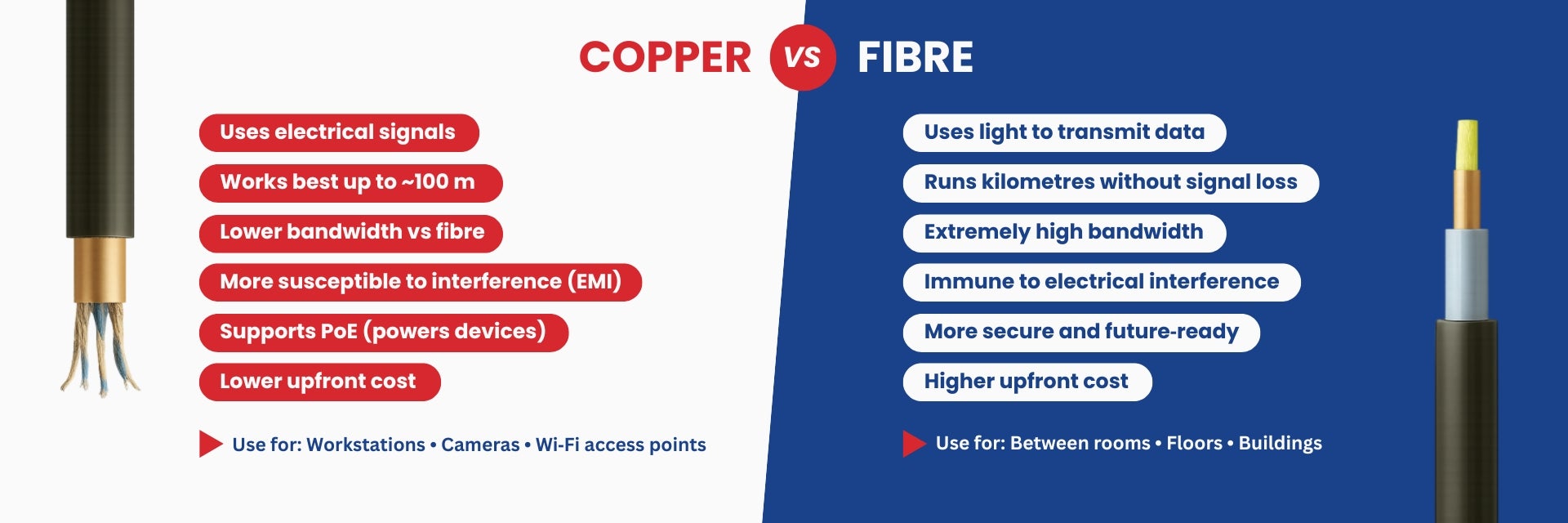
Structured cabling is where most of the physical work happens, but it’s also where long-term performance is determined.
Copper cabling is typically used for endpoints—connecting devices, workstations, access points, and cameras. Fibre, on the other hand, is used for backbone connections between rooms, floors, or buildings because it handles distance and bandwidth growth more effectively.
The key isn’t just selecting cable—it’s installing it in a way that supports performance, PoE requirements, and future expansion. Clean routing, proper support, and consistent installation practices make a significant difference over time.
A simple principle applies in most environments: copper to the device, fibre between spaces.
2. Racks, Cabinets & Cable Management: Organization That Impacts Performance

Once cable reaches the telecom room, organization becomes critical.
Racks, cabinets, and cable management systems determine how easy it is to terminate, test, maintain, and expand the network. A well-organized setup improves airflow, reduces strain on cables, and makes future work faster and safer.
This is often overlooked because it’s seen as a finishing detail—but in reality, it directly affects serviceability. A poorly planned telecom room leads to confusion, longer troubleshooting time, and higher long-term costs.
3. Network Power & UPS: Protecting the Entire System
Every device on the network depends on stable power. Without it, even the best installation becomes unreliable.
Uninterruptible Power Supplies (UPS) play a critical role by maintaining operation during short outages and stabilizing incoming power. Even brief interruptions—sometimes just seconds—can reset systems, disconnect devices, and disrupt operations.
At the same time, Power over Ethernet (PoE) has added another layer of complexity. Many devices now rely on the network not just for data, but also for power. This means proper planning of power budgets and switch capacity is essential.
When power is properly accounted for, systems stay online, equipment is protected, and downtime is minimized.
4. AV, Security & Low‑Voltage Systems: Where Everything Connects

Modern buildings are filled with connected systems—IP cameras, access control, meeting room technologies, and digital displays. All of these depend on the infrastructure you are installing.
This means your work extends beyond isolated tasks. A decision made during cabling or pathway planning can impact how these systems perform long-term.
It’s also critical to define expectations early. Is the project delivering installed infrastructure, or a fully operational system? Without that clarity, handovers can become unclear and timelines can slip.
A structured, standards-based approach ensures these systems can scale as new devices and technologies are added.
5. End‑to‑End Planning: Where Success Really Starts
Most installation issues don’t begin on site—they start during planning.
End-to-end support includes reviewing requirements, building a complete bill of materials, and aligning scope before materials are ordered. When this is done properly, execution becomes straightforward.
Instead of solving problems on the fly, you’re following a plan that already accounts for the full system.
Where Projects Go Wrong (and How You Avoid It)
Most Datacomm issues don’t come from major components—they come from missed details.
Here’s where to watch:
- Under-scoped pathways → missing supports, trays, fire ratings
- Incomplete materials → patch cords, labels, cable management
- Unplanned telecom rooms → no space, airflow, or layout
- Power gaps → ignored PoE budgets, no UPS protection
- No commissioning plan → no testing, no documentation, unclear handover
These are the gaps that lead to rework, delays, and lost margin.
Your Go-To Checklist That Prevents Most Issues
If you apply one thing, use this.
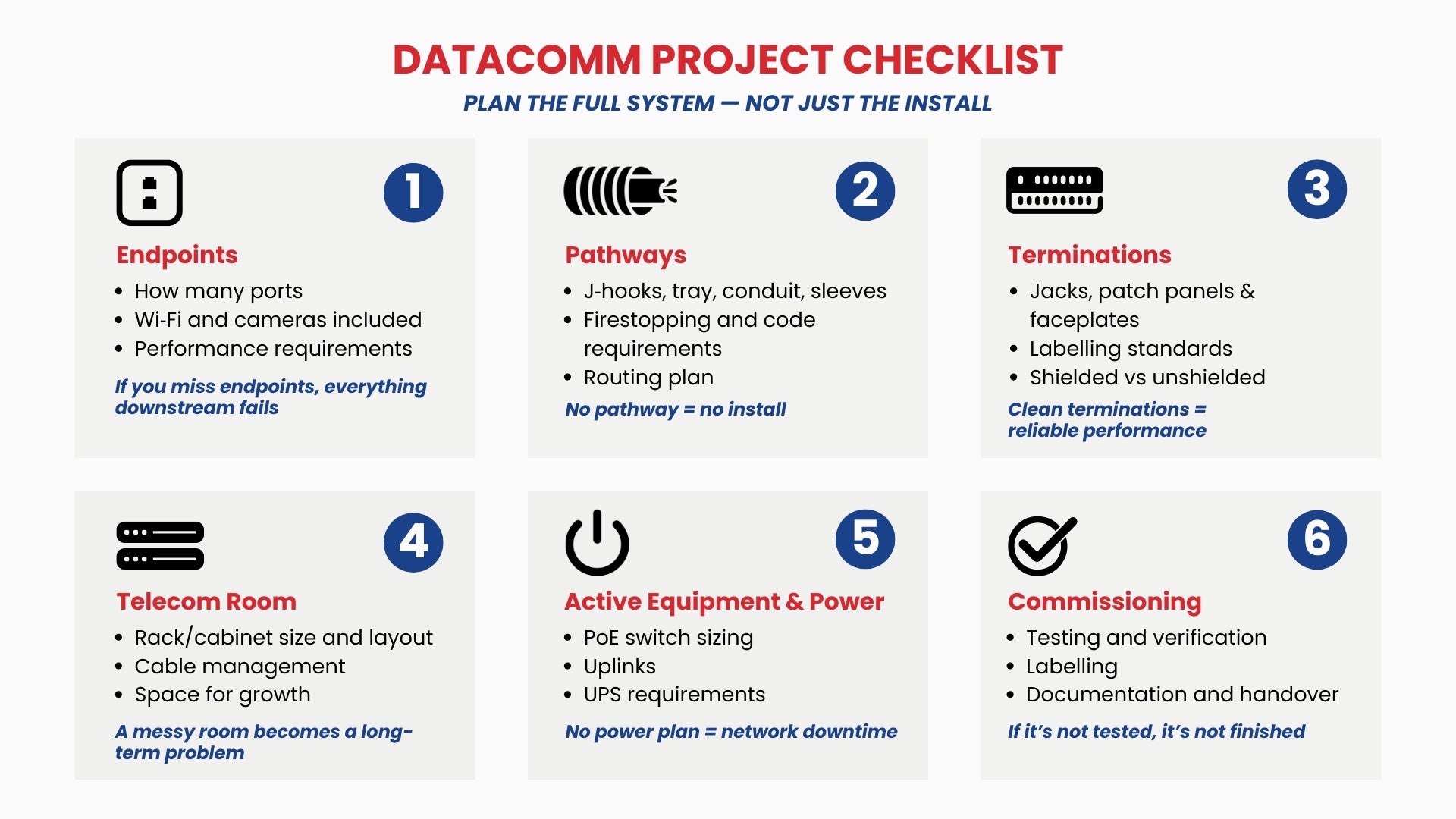
When you cover all six, you avoid surprises—and protect your profitability.
Why More Contractors Are Treating Datacomm as Critical Infrastructure
Datacomm is no longer “extra scope.”
It’s the foundation of how buildings operate:
- Security systems rely on it
- Communications depend on it
- Building automation runs on it
- Business continuity requires it
When you install it right:
- You reduce callbacks
- You improve system reliability
- You create upgrade-ready infrastructure
- You position yourself as a full-scope partner—not just an installer
How Gescan Datacomm Supports Your Projects
At Gescan Datacomm, the goal is simple: make your job easier and your projects more successful.
You get:
- ✅ Product expertise matched to real job conditions
- ✅ Local inventory to keep your project moving
- ✅ Design and specification support upfront
- ✅ Value-engineered options to meet budget
- ✅ A single-source partner across your Datacomm scope
From planning to completion, you’re backed by a team focused on reliability, scalability, and performance.
Final Takeaway
If you think of Datacomm as a complete system—not just cable—you work differently.
- You plan better
- You avoid rework
- You deliver higher-quality installs
- You build stronger customer relationships
And most importantly—you stay competitive.
Have Questions or Want to Learn More?
If you’d like to learn more about Datacomm infrastructure, discuss an upcoming project, or get support with planning and specification, Gescan’s Datacomm team is here to help.
Usama Saeed | Usama.Saeed@gescan.com
Datacomm Business Unit Manager
Kayle Dickson | Kayle.Dickson@gescan.com
Datacomm Specialist
Reach out to connect, ask questions, or explore how Gescan Datacomm can support your next project with reliable, scalable connectivity solutions.